
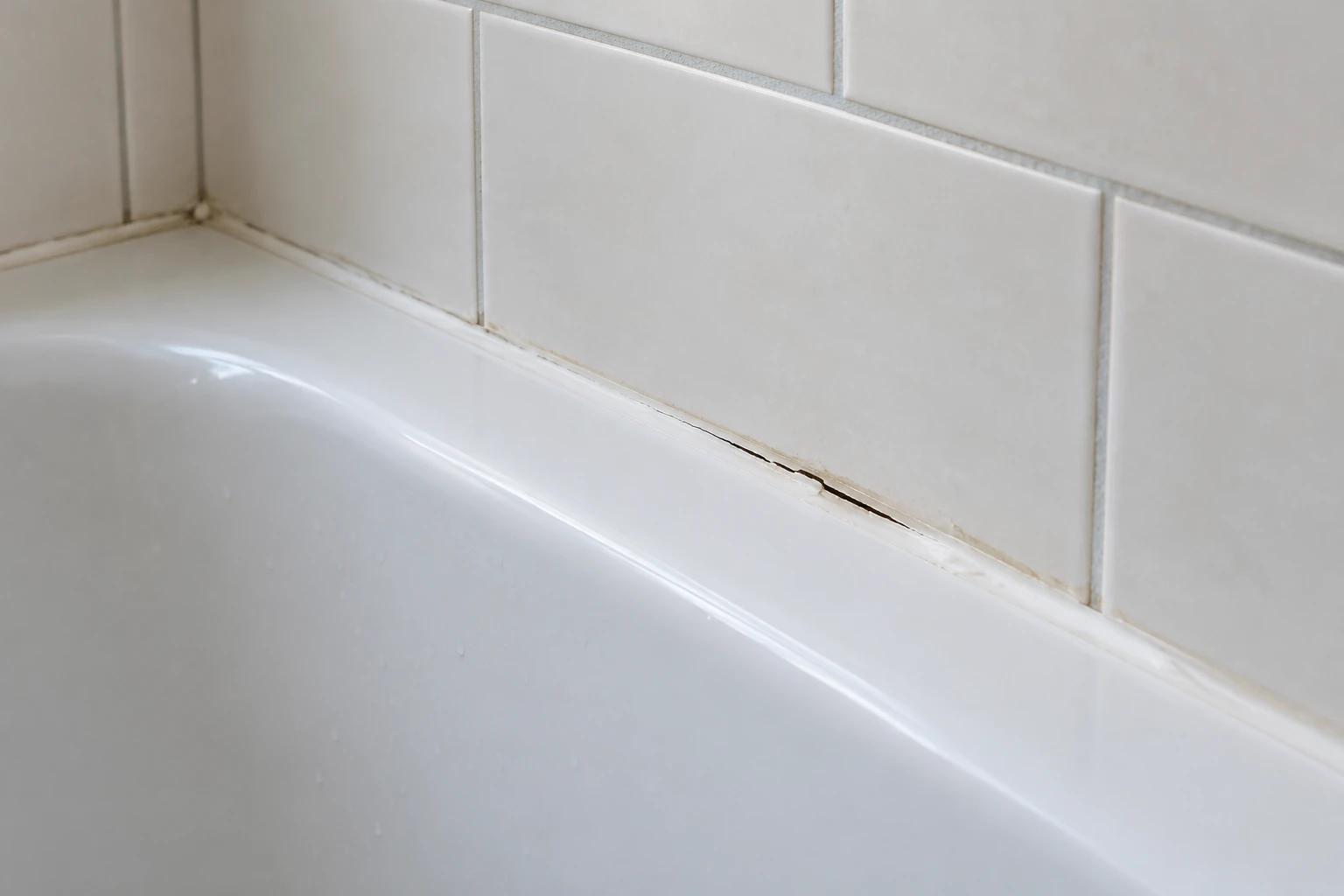
Signs the old caulk needs attention
Check the line where the tub meets the wall and the sealed joints in your shower. A split through the bead, a lifted edge, or a missing section means the seal is no longer continuous. GE Sealants identifies cracking, lifting edges, and mildew staining as signs that old sealant needs removal.
A narrow opening along one edge can be easy to overlook. For example, the caulk may still look smooth across the front while separating from the tub along the bottom. That separation matters even if most of the bead looks tidy.
Discoloration needs a closer look. A surface mark that cleans off is different from staining that remains in the sealant. DAP includes stains that cannot be cleaned among the reasons to replace shower caulk. Color alone does not establish whether there is a hidden moisture problem.
Caulk and grout do different jobs
Grout fills the joints between tiles. Flexible caulk or sealant is used at joints that need to accommodate movement, such as a change from a tiled wall to a tub. Matching colors can make the two materials look similar, but they are not interchangeable.
For example, CUSTOM Building Products specifies that its Fusion Pro grout is not for movement joints or changes of plane; those locations need an appropriate caulk or sealant. Follow the requirements for your particular tile, tub, or shower system when choosing the material and deciding which joints to seal.
Can you put new caulk over the old bead?
For a failed bathroom joint, plan on removing the old material rather than covering it with another layer. GE recommends removing the old bead and residue so new silicone can bond to the intended surface.
Preparation also includes removing soap residue and letting the area dry. DAP's shower-recaulking guidance calls for cleaning and drying before applying new sealant. A fresh-looking line over loose material does not correct the weak layer underneath.
When replacing the caulk may not be enough
A recurring gap, loose tile, a soft nearby wall, or water appearing outside the shower calls for assessment before resealing. These observations do not identify the cause, and a new bead should not be treated as a diagnosis or a complete leak repair.
If water is escaping into the room or a ceiling below, stop using the affected tub or shower and arrange an assessment of the leak. Describe where the water appears and when it happens, rather than assuming the visible caulk is the source.
What to discuss before the work
Clarify which joints need attention and whether the request is limited to removing and replacing caulk. Include any history of repeated cracking or water outside the bathing area. Useful details are:
- Whether the area is a bathtub, a shower, or a tub-and-shower combination.
- Which edges or corners are affected, with an overall photo and a close-up.
- The surface material, if known, and the preferred sealant color.
- Whether this is the only shower available in the home.
Ask when the shower can be used again. The wait depends on the selected sealant and its application conditions; a dry-looking surface is not a reliable guide. Follow the exact product's water-exposure instructions when planning around the work.
Need help with bathroom caulking?
Caulking is part of the General Repairs work I offer in Linden and nearby New Jersey towns. Text me a photo, a short description, and your town or ZIP so I can review the request and confirm whether I can help.
Sources
- GE Sealants — Can you use silicone sealant over old sealant?
- DAP — How to Re-Caulk a Shower
- CUSTOM Building Products — Fusion Pro grout technical data sheet, limitations
For material compatibility, joint details, and water-exposure times, follow the instructions for the exact products and tub or shower system.